It's a Rap

creating partnerships to develop a dynamic, robust, well-prepared educator workforce


  • Service to Workforce Pipeline: Building the Next Generation of New York Teachers

    There is a unique energy that comes from a year of service. It’s the feeling of being “all in,” dedicating your time, skills, and heart to a cause bigger than yourself. At its foundation, education is a service career, educators recognize this same commitment as they enter the classroom each and every day, driven by a shared purpose to support young minds and the broader community.

    That’s why we are proud to launch AppleCORE, a Registered Apprenticeship Program working in concert with a NYS AmeriCorps service program, designed to bridge a passion for community impact with a clear, supported pathway into a professional career in education.

    AppleCORE is more than a stand-alone service opportunity. It is a specialized workforce pathway into the teaching profession. By weaving together the separate strands, AmeriCorps national service with a Registered Apprenticeship Program (RAP), we have created a model that removes traditional barriers by providing educational support, a living stipend for service, cohort participation, leadership training, and additional hours of paid, on-the-job learning.

    Through AppleCORE, aspiring teachers serve their communities while simultaneously earning their New York State Initial Teacher Certification. This “woven” approach offers comprehensive support, including tuition assistance, emergency support, and hands-on guidance, ensuring that aspiring educators are as well supported as the students they serve.

    Service years are not just a “good thing to do” to give back. They are a powerful engine for workforce development. Historically, service programs have served as vital career on-ramps in high-need sectors such as healthcare and climate resilience. As New York schools face significant hiring challenges, AppleCORE applies this proven model to education, aligning service, training, and credential attainment.

    National research underscores the effectiveness of the service-to-workforce pipeline. Findings from the Service Year Alliance Pathways After Service Report show that:

    • Service year participants without a bachelor’s degree are more than twice as likely to go on to earn one compared to peers with equivalent years of work experience.
    • 31 percent of service year alumni begin their careers in education, community, or social services, compared to 8 percent of their peers. After ten years, 23 percent remain in these fields, compared to 7 percent of non-participants.
    • Service year alumni are significantly more likely to demonstrate and market key workforce ‘soft’ skills, including leadership, collaboration, organization, and teamwork.

    By intentionally connecting service to a credentialed career pathway, AppleCORE strengthens New York’s educator pipeline while honoring service as both a public good and a workforce strategy.

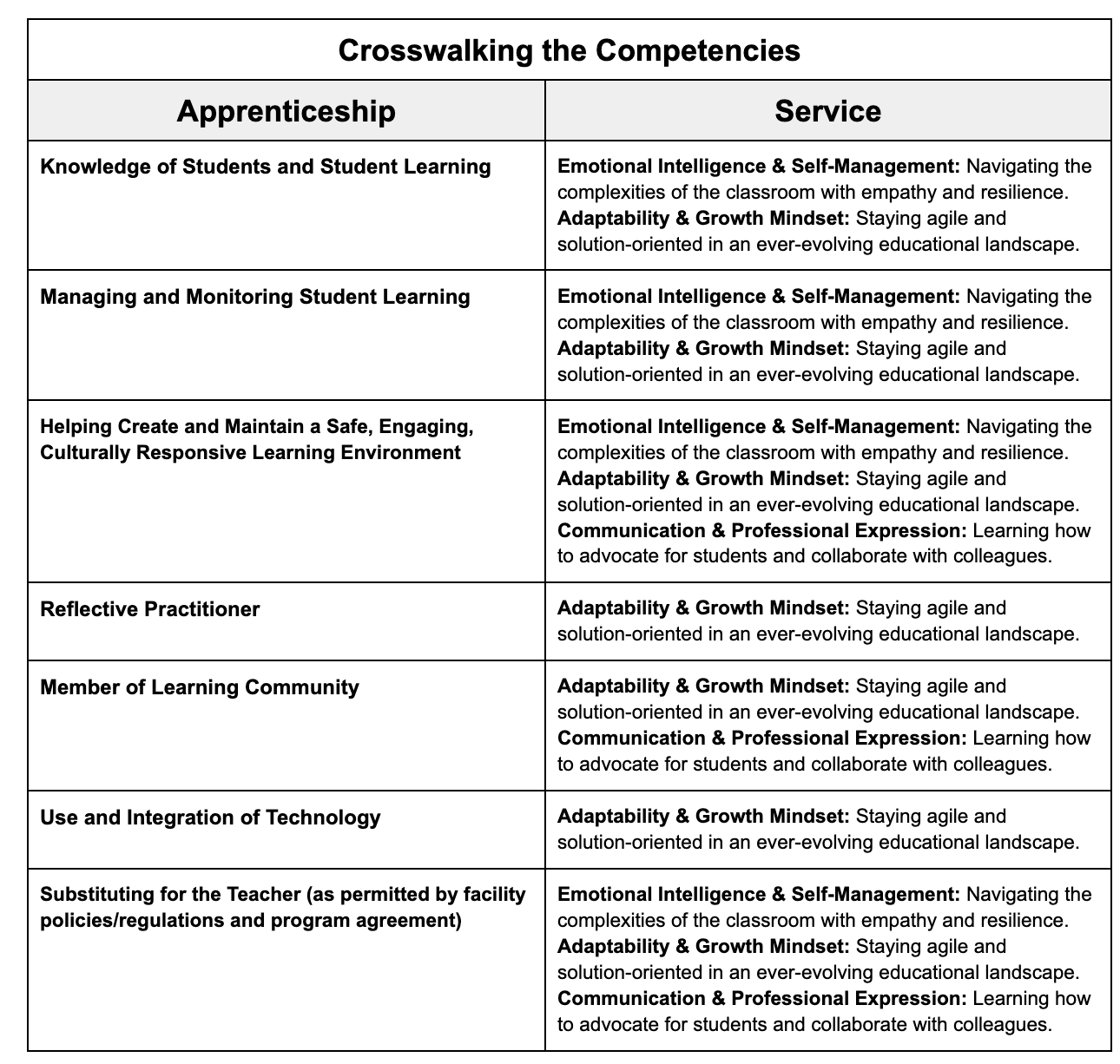
    AppleCORE prepares aspiring educators to both teach and lead in their communities or from the classroom. Members build lasting skills in communication and collaboration with students, families, and colleagues.They strengthen emotional intelligence and self-management to support student learning and personal resilience, and they develop adaptability and problem solving with a growth mindset to thrive in dynamic school environments. At the same time, AppleCORE members become active contributors to their school communities and classrooms, building strong relationships and a shared sense of purpose. Through service, they see firsthand how educators can strengthen communities, create stability for students, and make a lasting, collective impact beyond the classroom.

    As an apprentice the AppleCORE member meets eight apprenticeship competencies that align closely with the service competencies.
    For decades, AmeriCorps and other state and national service organizations have demonstrated that service is not only a public good, but also a powerful pathway into the workforce and a proven foundation for developing strong community leaders in high-need professions. Service experiences build essential skills, professional identity, and a deep commitment to community impact.

    By pairing service with a Registered Apprenticeship, this work moves beyond career exposure and leadership development to create more intentional, structured workforce pathways. AppleCORE will build on this foundation by partnering with established NYS service programs, including SUNY’s Empire State Service Corps and City Year, to serve as pre-apprenticeship service partners. Together, service and apprenticeship create a seamless bridge from purpose-driven service to sustainable, long-term careers.

  • Strong Educators, Strong Workforce: A Shared Investment in New York’s Economic Future

    Strong communities are built on a strong education system. New York State is facing a critical and escalating educator workforce crisis. Persistent shortages, high turnover, and barriers to accessing high-quality pathways in child-focused careers are leaving education agencies and classrooms understaffed. This impacts the system from early childhood through high school resulting in a widening of opportunity gaps and the weakening of community well-being. Without urgent, targeted investment in the workforce, which supports children from birth through graduation, these shortages threaten the long-term strength of New York’s communities and its economy.

    Every child-serving field is facing severe staffing shortages, with too few people entering these roles to meet demand. These gaps stretch across the continuum, from childcare and teacher assistants to CTE, English, math, science, special education, and school leadership. Behind every skilled worker and creative thinker are the professionals who nurtured and guided them, yet without a qualified workforce supporting New York’s children, communities suffer, learning goals go unmet, and educators face increased burnout and turnover.

    When we talk about the health and strength of New York State’s economy, we often focus on innovation, infrastructure, and industry. We highlight exciting pathways to emerging careers for our future workers, yet we speak far less about the adults in the continuum of care who nurture and guide them along the way. A well-trained, well-supported child-focused workforce forms the backbone of every sector. This child-centered network of caregivers, educators, and youth-support professionals is a pivotal gear in the system that powers New York State’s economy, developing the critical thinkers, creators, and workers who will drive every industry sector forward.

    Investing in the child-focused workforce is one of the most powerful economic decisions New York can make. These educators and caregivers, working alongside families and community partners, are the single strongest in-school influence on a child’s success. And their impact reaches far beyond test scores. Decades of research show that when we invest in students’ social and emotional development, we see lasting gains in health, education, career readiness, economic mobility, and community well-being, a return on investment few other sectors can match. By building confidence, curiosity, and essential life skills, these professionals ignite potential and help young people see themselves as future contributors to their communities and future careers.

    And this work begins well before kindergarten. Early childhood programs lay the foundation for lifelong learning, shaping cognitive, social, and emotional development during the most critical years of brain growth. High-quality opportunities from birth to age five set children on a trajectory for success, they enter school better prepared, with stronger language, literacy, and math skills, and are more likely to graduate and thrive. But none of this is possible without qualified, well-supported adults in these roles. Investing in and preparing this workforce is not optional, it is essential to giving every child in New York the strong start they deserve.

    Beyond recruitment, retaining talent is an essential financial strategy, as turnover places a heavy burden on school budgets. Longer, immersive preparation programs, like educator apprenticeships and teacher residencies, have an 89% retention rate, compared to around 50% in traditional programs and just 15% in quick-entry alternative certification routes.  And the cost? A NYSSBA analysis found that districts outside New York City spend an average of $260,000 annually on turnover-related costs, with substantial regional variation: Finger Lakes districts experience the highest average costs ($352,046), while North Country districts spend the least ($117,976). These taxpayer dollars would be better spent contributing to a workforce that stays, benefitting the children served.

    “Supporting preparation models like Registered Apprenticeship means we’re not just educating young learners; we’re building the next generation of workers, entrepreneurs, and community leaders. When aspiring educators can earn as they learn and stay in the field, we create a ripple of benefits: better student outcomes, lower remediation costs, and a stronger pipeline of home-grown, career-ready graduates. In turn, our businesses win, our communities win and New York wins.”

    Brian Williams, Executive Director, Capital Region Workforce Development Board

    Entering a career to support the children of NYS  should be determined by interest and commitment, not prohibitive costs. The reality is that becoming an educator through the traditional route is expensive and often lacks the support candidates need to succeed-from financial assistance and high-quality mentorship to childcare, transportation, and emergency services. When these barriers are removed, we expand access to the profession, strengthen the workforce, and create meaningful opportunities for economic mobility within communities.

    Accessible, high-retention educator pathways are a direct investment in New York State’s future workforce and economic prosperity. Together through this investment, NYS will build a comprehensive, child-centered workforce that nurtures the next generation of thinkers, workers, and leaders necessary  to strengthen its communities and  ensure a thriving future for all.

  • The Critical Role of Principals in Teacher Retention

    As schools across the country face crippling educator shortages, retaining qualified educators has become equally  as important as recruiting them. While many factors influence a teacher’s decision to stay or leave, one of the most impactful is school leadership. Principals play a central role in shaping the work environment, school culture, and support systems that directly affect teacher satisfaction and long-term commitment. The deeper the  work to create pathways for greater teacher retention, the more it reinforces the importance of administrators to achieve that goal.  

    The Data 

    Research consistently shows that strong school leadership is closely linked to higher teacher retention. According to the Learning Policy Institute (2021), teachers who rated their school leadership as effective were significantly more likely to stay in their positions compared to those who did not. Principals who foster collaboration, communicate a clear vision, and support teachers’ professional growth create a positive school climate that encourages educators to remain in the profession.

    Many studies identify working conditions as a major factor influencing teachers’ decisions to leave. Principals play a pivotal role in shaping these conditions by determining how much teachers can participate in decision-making, collaborate with colleagues, and access instructional support. These factors all contribute to teachers’ sense of collective efficacy and job satisfaction, highlighting the critical importance of investing in strong school leadership.

    Research from Brookings demonstrates that when a principal leaves a school, it can have far-reaching effects, including increased teacher turnover and declines in student achievement. In response, some states and districts have developed registered apprenticeship programs for principals and school building leaders. These programs aim not only to improve the quality of school leadership but also to retain effective principals. By providing hands-on, one to two year clinical experience and sustained mentorship, apprenticeship programs build leadership capacity in a way that strengthens school culture, supports teachers, and ultimately benefits students.

    Registered Apprenticeships for School Building Leaders 

    The launch of principal apprenticeship initiatives was driven by challenges similar to those faced in the teaching profession, particularly high rates of leadership turnover in schools nationwide. By investing in structured leadership development, states aim to create more supportive and effective school environments. These programs not only strengthen the leadership pipeline by preparing principals for the complex realities of school leadership but also contribute to teacher retention and professional growth, helping educators stay in the profession and thrive throughout their careers.

    In response to this need, EdHUBNY not only worked with the NYS DOL to create the title of School Administrator/Building Leader, they also used this experience to collaborate with Pathways Alliance and other partners developing the 2025 National Standards for the Principal Occupation Apprenticeship, for Federal Review. These standards are used in USDOL Office of Apprenticeship states to define the expectations for K–12 principals entering the profession through an apprenticeship model.

    The apprenticeship term is based on the apprentice’s demonstrated mastery of specific competencies outlined in the specific state or federal standards. In NYS, apprentices are enrolled in a NYSED approved administrator certificate or Master’s program, completing the related instruction leading to initial school administrator certification.  

    From the field 

    Harpursville Central School District has been a champion for building strong principal leadership through its innovative apprenticeship model. In a recent presentation, district leaders highlighted the impressive progress taking place at Harpursville Jr./Sr. High School over the past two years. Discipline referrals have dropped by 56%, creating a calmer and more supportive learning environment. Chronic absenteeism has also declined by 11%, reflecting stronger student engagement and a deeper connection to the school community.

    These results demonstrate the powerful impact that effective leadership and intentional relationship-building can have on an entire school community, fostering meaningful and lasting improvements in school culture and student success. The apprenticeship model allows aspiring principals to be fully embedded in the daily administrative work of their district. In many cases, these candidates come from within the school itself, which helps strengthen relationships, continuity, and the overall school culture.

    Superintendent Heath Georgia shared his perspective on the program’s success, noting,

    “The depth and breadth of what Brian (Apprentice) is doing far exceeds that of others in traditional coursework. He’s fully embedded, experiencing leadership in real time, discussing it daily with our administrative team, and applying what he’s learning immediately. That kind of immersion is powerful.”

    The success at Harpursville stands as a powerful example of how investing in leadership development can create lasting, positive change for schools, staff, and students alike. Strong leadership development impacts everything from teacher retention to student achievement, shaping the foundation for thriving school communities.

  • Buffalo City School District Builds Teacher Pipeline Through Apprenticeship

    In a recent conversation with leaders from Buffalo City School District (BCSD), I had the opportunity to learn more about their innovative efforts to strengthen and diversify the educator workforce through a Registered Apprenticeship Program (RAP). Now in its second year, the program is already shaping the district’s approach to long-term staffing and career development in high-need certification areas.

    Why Apprenticeship?

    District leaders shared that their decision to register an apprenticeship program for teachers stemmed from multiple needs: to build an educator workforce more reflective of the student population, address persistent shortages in areas like special education, and create sustainable career pathways for individuals already working in their schools.

    “We believed the apprenticeship model could help us meet these goals,” shared Elizabeth Campion, Supervisor of Teacher Pathways at BCSD, “Especially by expanding access for individuals from underrepresented backgrounds and those already committed to working in education.”

    The program builds on Buffalo’s previous success with teacher residency models. With support from the SUNY Apprenticeship Program and funding from the Apprenticeship Expansion Grant (AEG), the district saw apprenticeship as a scalable, long-term solution to expand and stabilize its educator pipeline.

    A Grow-Your-Own Approach to Recruitment

    Buffalo’s recruitment strategy focuses heavily on internal candidates, particularly Teaching Assistants and school staff who already hold a bachelor’s degree and are interested in pursuing teacher certification.

    “These individuals are deeply invested in our students and our schools,” added Richard Thompson, Instructional Specialist III, of Buffalo Public Schools. “They already understand our systems, and apprenticeship offers them a clear, supported pathway into [a teaching role in] the classroom.”

    In addition to internal recruitment, the district also promotes the program through newspapers, online job boards, and partnerships with colleges and universities. Buffalo is leveraging apprenticeship to retain and grow local talent, even as educator preparation programs face statewide enrollment declines.

    Early Outcomes and Observations

    Although the program is still in its early stages, district leaders are optimistic about its potential. While formal data has not yet been collected, the district draws from six years of experience implementing teacher residency programs, where co-teaching models have led to positive impacts on student learning. Elizabeth expressed,

    “We’ve seen the benefits of having an additional adult in the classroom. Students benefit. Teachers benefit. We believe we’ll  see the same results with apprenticeship, and we’ll be tracking that over time.”

    Navigating Administrative Complexity

    Implementing the apprenticeship program has not been without challenges. Differences between residency and apprenticeship requirements and terminology has required the district to adjust its administrative processes and reporting systems.

    A key part of the district’s success has been building a strong working relationship with the New York State Department of Labor through EDHUBNY. Support from EDHUBNY has been instrumental. “They’ve guided us through every step of the process,” Richared noted. 

    Sustainability

    Buffalo’s apprenticeship program is currently supported by a combination of AEG funding, SUNY Apprenticeship support, and EDHUBNY start-up funds. While these sources have helped launch the program, district leaders acknowledged the need for additional resources, particularly to support mentor teachers who play a critical role in the success of apprentices.

    “We’d like to see future funding that helps compensate mentor teachers, including university-based mentors,” they said. “These individuals are essential to program quality.”

    The district is actively exploring additional funding streams, including potential future grants and federal programs such as EdHUBNY’s AppleCORE, their new AmeriCorps program, to ensure the program’s sustainability and growth.

    Looking Ahead

    Over the next five years, Buffalo City School District aims to expand the number of apprentices participating in the program and continue building a robust, high-quality educator  pipeline. Particular emphasis will remain on staffing hard-to-fill positions in areas such as special education.

    “Registered Apprenticeship has been a valuable tool. We’re committed to continuing this work and refining the model to meet the evolving needs of our schools and students.” Richard Thompson , Instructional Specialist III, Buffalo City School District

  • Apprenticeship in Action for Future Educators

    Meet Lexi, a high school and college graduate, and a working mom. She began her career in education as a teacher aide in Hoosick Falls, NY, where she quickly discovered a deep passion for working with students and a natural talent for supporting their learning. Despite how much she loved the role, Lexi knew that an aide’s salary wouldn’t be enough to support herself and her young son.

    Already holding a bachelor’s degree in hospitality, Lexi realized that access to a future career as a teacher by returning to a traditional teacher preparation program, with its unpaid student teaching component was not feasible. There had to be another way. The Classroom Academy’s two-year Apprenticeship Program offered her a vital alternative, enabling her to earn a steady income while gaining the practical experience and credentials necessary to become a certified teacher. It would also provide some relief with tuition assistance. This balance of work and study allowed her to pursue her goal of teaching without starting over financially or professionally.

    At first, Lexi felt most comfortable in special education classrooms, where she had the most experience from her position as a teacher aide. Transitioning to a first grade classroom brought new unknowns, yet  strong support and daily, hands-on experience and guidance helped her develop the tools and confidence needed to expand her teaching practice. As Lexi explains,

    “I wasn’t sure I could teach in a general education setting at first, but with the right support and experience, I’ve learned that I’m capable of meeting the needs of all my students.”

    Lexi also acknowledged that the year came with its share of challenges. A change in school leadership and the temporary absence of key staff members due to maternity leave created significant shifts within the school community. However, she and her lead teacher were able to lean on each other and navigate these transitions together. These types of collaborative responses to common realities which educators face every year, are often missed in short-term traditional student teaching placements. Additionally, Lexi’s lead teacher was able to draw on Lexi’s special education experience, enriching both the classroom environment and student learning.

    Now entering her second year in the program, Lexi reflects on how impactful the first year has been building her skills, confidence, and teaching identity. One of the unique benefits of the program, which Lexi sees as a powerful part of her growth, is the opportunity to work with a new group of students this coming school year. Each class brings its own personality, learning needs, and challenges, requiring her to adapt and approach her teaching with fresh strategies and an open mind. The variety has helped her better understand the realities of the classroom and what it means to be a responsive, reflective educator.

    “The classroom experience has given me so much to learn and  things I’ll carry with me for years to come. Last year was so different from this year; the needs are higher now. Being able to experience that shift across two years is incredibly valuable.”

    With one successful year behind her and a new class ahead, Lexi is continuing to grow into her role as a dual-certified teacher, ready to serve diverse learners across the school community.

  • Trends to watch in Registered Apprenticeship Programs for Educators

    Emerging Trends in Registered Apprenticeship Programs for Educators 

    As the NYS Educator Workforce Development Hub, we are closely tracking the strategies and policies reshaping how educators are trained, supported, and retained within the state and beyond. These shifts are not just about improving and building pipelines, they are a representation of meeting the needs of the school community and have been shaped by learning from early adopters in the field. Here are four key trends that anyone working to strengthen the educator workforce, whether you’re a school leader, policymaker, or workforce partner, should be paying attention to.

    Trend 1: Expanding Registered Apprenticeships Across Educator Roles
    Registered Apprenticeship Programs in education are no longer limited to aspiring teachers. They’re being used to develop the full range of school and early childhood professionals. In New York State alone, the HUB has supported the creation of 16 RAPs for teacher assistants, teachers, and even school administrators, with 20 more programs currently in development. It is also supporting the development of a Childcare Program Administrator title with NYSDOL and childcare assistant programs with partner sponsors.  This expansion reflects a broader reimagining of the educator career ladder, where multiple on-ramps and growth opportunities can coexist across the entire age spectrum. By building structured, supported pathways across different roles, RAPs not only bring more people into the profession but also create internal advancement opportunities for those already working in schools. It’s a new model of professional mobility, grounded in experience and sustainability.

    Trend 2: Tapping into Paraprofessionals and Teaching Assistants
    Speaking of on-ramps, school and early childhood systems are increasingly recognizing the untapped potential of paraprofessionals and other support staff. These individuals are already embedded in classrooms and programs, know the children  and communities they serve, and are often representative of the populations most in need of high-quality educators and program support.  Yet many face systemic barriers to entering the field, such as certification, including cost, time, and lack of formal mentorship. RAPs offer a solution. By allowing paraprofessionals and other support staff to earn credentials while working and receiving mentorship from experienced educators and staff, these programs turn school or program based experience into upward career mobility. It’s a strategy that not only fills vacancies but also fosters retention in the profession.

    Trend 3: Grow Your Own Meets Apprenticeship
    “Grow Your Own” (GYO) programs have emerged for recruiting future educators and program staff from within the communities they will serve. When paired with the RAP model, GYO efforts become structured, paid pathways into careers serving children (including teaching) for high school students, paraprofessionals, career changers, and community members. RAPs bring rigor, formal mentorship, and credential attainment to GYO pipelines, transforming local talent into highly prepared, credentialed educators. This is especially effective in rural and urban districts struggling with persistent shortages. Embedding RAPs into GYO strategies not only strengthens the pipeline but ensures those entering the field are ready and committed to stay.

    Trend 4: Leveraging Embedded State and Federal Funding
    The secret sauce to the funding and sustainability of these programs remains in development. The growth of educator RAPs is being made possible by a smart alignment and braiding of funding streams. At both the state and federal levels, new and existing resources are being leveraged to support the design and sustainability of these programs. Many programs figuring out how to tap into WIOA dollars.  The Workforce Innovation and Opportunity Act (WIOA) is the primary federal law guiding the nation’s workforce development system. Each year, WIOA funding is allocated to states based on a federal formula. States then distribute the majority of these funds to local workforce development boards, which are responsible for determining how the money is invested in training, education, and employment services within their regions. In NYS, these funds go from the board directly to the apprentice (once they qualify) through Individual Training Accounts and can sometimes also support other emergency or wraparound support for the apprentice.

    Another federal resource that travels through the states is the State Apprenticeship Expansion Formula (SAE) Grants. The U.S. The Department of Labor’s five-year SAE grant program supports states in expanding Registered Apprenticeship opportunities in high-priority sectors. SAE funding is distributed in two ways: formula-based base grants and competitive grants. While base grants are typically smaller, they are awarded more broadly to a larger number of states and territories. In contrast, competitive grants provide more substantial funding to support innovative or large-scale apprenticeship initiatives and states with state apprenticeship agencies are limited as to how many they can receive. Apprenticeship Building America Grants are also federally funded.  These opportunities, awarded in 2022 and 2024, are increasingly being applied to support educator apprenticeships. Adding to this pool of funds, some state governments or state agencies have appropriated state dollars to support registered apprenticeship, and in some cases, have even set aside funds to support registered apprenticeships for educators specifically. 

    What’s Next

    At its core, this work is about people, building real, supported pathways for those who want to make a difference in classrooms, childhood programs and communities. Whether it’s a paraprofessional who’s been serving children and students for years, a high school student dreaming of becoming a teacher, or a career changer looking for a meaningful next chapter, Registered Apprenticeship Programs are opening doors that were too often closed.

    These trends highlighted are just the beginning. As educator Registered Apprenticeship Programs continue to grow, the next phase of this work will focus on deepening impact and expanding access. Here’s where we’re headed:

    • Supporting program design and implementation
      We’ll continue partnering with lead education agencies, higher education institutions, and workforce boards to design programs that reflect local needs and remove barriers for candidates.
    • Strengthening data and impact tracking
      Understanding what’s working, and where there’s room to grow is key. We’re investing in better ways to track outcomes, share lessons learned, and inform policy.
    • Expanding partnerships
      Cross-sector collaboration is essential. We’ll be building stronger connections between education, workforce, and higher ed to ensure programs are aligned, supported, and sustainable.

    Advocating for policy and funding alignment
    Continued growth depends on smart policy and investment. We’ll keep working at the state and federal levels to secure resources that support long-term success.

  • Part 1: Laying the Foundation to Build a Pipeline for Special Education Teachers Using Apprenticeships

    Over the past few years, I’ve worked closely with school systems and education leaders across NYS who are urgently trying to fill special education teaching roles with effective, well-prepared educators. But the challenge is growing. Special education positions are among the most complex in any school and increasingly, the hardest to staff. According to federal data, as of 2023–24 school year, 21% of public schools reported unfilled special education roles more than any other subject area. Even more concerning, 8% of those teaching students with disabilities under the Individuals with Disabilities Education Act (IDEA) were not fully certified. 

    This growing gap demands scalable, sustainable workforce solutions. One promising insight comes from the CEEDAR Center: paraprofessionals who become certified teachers are more likely to enter the field of special education. These individuals are already supporting students in schools, often come from the communities they serve, and bring valuable on-the-ground experience. Research also shows that when paraprofessionals transition into teaching roles, they are more likely to stay in the profession long-term and deliver high-quality instruction, due in large part to their practical classroom experience.

    But despite their potential, many face real barriers: time, cost, and a lack of flexible preparation programs. As we’ve noted in previous blog posts, traditional teacher prep often forces paras to choose between earning a paycheck and earning a degree which, for most, isn’t a real choice at all.

    As states begin to better recognize the critical role paraeducators can play in addressing special education teacher shortages, they’re also realizing that making the pathway accessible is key. That’s where Registered Apprenticeship programs come in. They allow candidates to “earn while they learn,” blending paid work with coursework and mentorship. It’s no surprise, then, that of the 51 Registered Teacher Apprenticeship programs operating across the country today, 48 include special education as a field of study. 

    Take Minnesota for example, highlighted in the CEEDAR brief, they have taken specific steps to build ITRAC, a Registered Teacher Apprenticeship program preparing special education teachers to teach students with autism spectrum disorders (ASD) and emotional and behavioral disorders (EBD). Sponsored by the non-profit educational cooperative BrightWorks, the ITRAC program offers paraprofessionals a no-cost pathway to becoming teachers. Participants serve as apprentices, engaging in two years of hands-on, job-embedded learning within partner Intermediate School Districts (ISDs), while receiving supplemental coursework from MSU-Mankato. Program partners are dedicated to filling all positions with highly qualified educators and to retaining and building on the expertise of their existing staff.

    Likewise, in New York, Kennedy Children’s Center provides a powerful example of how paraprofessionals already support students with significant disabilities in specialized settings. Organizations like Kennedy are natural candidates for Registered Apprenticeship models, given their commitment to inclusive education and their experienced workforce. With the right policy supports, they have shown the real return-on-investment and are at the forefront of growing the special education pipeline locally with 100% staffing and a waitlist to join the program.

    In many ways, Registered Apprenticeship Programs for special education just make sense. They’re a practical solution to a pressing need. What’s even more compelling is that the answer might already be right in front of us: the paraprofessionals who are already in our schools, already supporting the very students who need the most skilled and consistent support. They know the kids, the classrooms, the challenges, and many are eager to do more. But without a flexible, affordable pathway into the profession, their talent and potential often go untapped. Apprenticeship unlocks that potential. It doesn’t just fill vacancies, it invests in the people who’ve already shown up, day after day, for students with disabilities.  In Part 2 of this mini-series, we will explore the context of NYS more deeply with the adjustments at the NYS Education Department and how districts, BOCES, and privates are working to leverage this resource, growing teacher assistants and then supporting them to become teachers.

    Stay tuned!

  • Decision Point: Embarking on a Teacher Apprenticeship Pathway

    With traditional educator preparation programs struggling to attract new candidates, particularly in rural areas, innovative approaches like New York’s Registered Apprenticeship Program are helping career changers like Olivia find their way into the classroom and build lasting careers. We sat down with Olivia to learn about her experience as a Teacher Apprentice with Classroom Academy.

    Like many aspiring educators today, Olivia’s path to teaching wasn’t linear. She came to education as a career changer. Her story made me wonder: how many talented individuals are “hiding in plain sight,” ready to make a meaningful impact in education if given the right pathways?

    Olivia, a native of Port Jervis, New York, began her journey studying Journalism and Public Policy at Ithaca College. It was a summer job at a local rec center working with children that changed everything.

    “The kids made me view the world differently,” Olivia recalls. “Their curiosity, creativity, and how they saw things—it really stuck with me.”

    As Olivia began exploring educator preparation programs, she was drawn to SUNY Empire’s residency model. What stood out even more was discovering Classroom Academy, SUNY Empire’s Registered Apprenticeship Program. Rather than follow the traditional route of two short, unpaid student teaching placements, Olivia chose the apprenticeship pathway, spending two full years immersed in the classroom in a paid position, working alongside and learning from an experienced teacher.

    “I wanted to learn by being in the classroom every day, not just from textbooks,” Olivia explains. “Classroom Academy gave me hands-on experience right from the start.”

    Now placed at Cambridge Central School District as a Teacher Apprentice, Olivia works with Jason Sutliff, a seasoned English teacher with over 20 years of experience, and has quickly found her passion for teaching middle school students.

    “Jason is such a true teacher to his core. He never makes me feel like I’m doing something wrong. He teaches me. I feel supported at every step and that makes all the difference.”

    Moving a few hours away from home to a small, rural community posed its own set of challenges for Olivia. “I didn’t know anyone when I first arrived. It was a little intimidating being so far from home,” she admits. 

    “… I quickly realized that this community, both the school and the local area, has been incredibly welcoming. People here want to see me succeed, and that sense of support is important” 

    Classroom Academy attracting career changers across the state is a success in its own right. This may show a promising way to attract career changers to the classroom. 

    The support from the Classroom Academy program has also been crucial for Olivia in developing her teaching style. Having a support network including the program coordinator,  Colleen Lester, as well as additional support from professional community facilitator Rita Floess has helped her navigate her first year with confidence. “They check in on us, give advice, and make sure we’re always growing,” she shares. “It’s a lifeline to have that support when you’re just starting out.”

    In addition to the Classroom Academy support system, Olivia has also built a strong network within the school, which has helped her feel more connected and grounded. “I’ve had the chance to sub in other classrooms, attend career fairs, and interact with staff members from different parts of the school,” she says. 

    Olivia credits the strong support from teachers, staff, and parents for her growth and sense of belonging in the school community. Hearing her speak so passionately about this network really struck me, it’s clear that feeling connected beyond the classroom is vital for new educators’ success.

    She encourages others to commit to the two-year apprenticeship program, reminding us that the time will pass anyway and the experience provides essential tools and guidance to truly make a difference, not just academically, but in supporting students’ emotional growth as well. Olivia’s confidence about stepping into her own classroom left me inspired; she’s ready to take on whatever challenges come her way, and her story shows just how powerful this hands-on, supported approach can be.

    Hear from some of Classroom Academy’s other participants below!

  • Sustainability as a Mindset

    As the school year wraps up, educational agencies are grappling with a critical question: How do we build programs for sustainability in an ever-evolving landscape? 

    In a time of shifting political winds, uncertain funding, and evolving school needs, sustainability can’t be a checkbox, it must be a mindset. As the HUB’s Director put it, “Sustainability is beyond funding, it is a mindset.” It’s a way of thinking that embraces adaptation and flexibility, centers local needs, and plans not just for implementation, but for long-term impact. This mindset makes launching a registered apprenticeship program for educators just the beginning. 

    Sustainability is typically looked at through the financial lens. Education agencies can’t afford to depend on a single grant, legislative window, or policy trend. Long-term sustainability requires a braided and blended funding approach, combining local district investment, federal and state apprenticeship support (when available), workforce development funds, financial aid, individual investment and philanthropic partnerships. The key to financial sustainability is the ability to be resourceful and adapt to the funding streams available at any given time.

    Embracing a sustainability mindset shifts the thinking from compliance- focused budgeting to resilience-focused planning. For schools, this means embedding apprenticeships into broader talent development and retention strategies that are part of the year to year operational funding.  Think of it as throwing a pebble into the stream where it will become one of many that make up the stream bed. For policymakers, it means designing frameworks that support ongoing evolution, without requiring new legislation every time conditions change.

    So what does sustainability as a mindset look like in action? 

    Sustainability as a mindset, means more than just dollars as it is also designing programs that can adapt. Sustainable apprenticeship models are adaptive, to iterate, adjust, improve, reflect and respond to real-time learning. This includes redesigning mentoring models, working with higher-education partners to adjust coursework delivery based on apprentice needs, or shifting recruitment strategies based on local workforce data.

    For policymakers, this mindset requires trust in the field, shaping accountability structures that support improvement and allow for adjustment not just compliance. For program leaders, it means building time and space for teams to assess, revise, and improve systems in real time.

    In today’s climate, where education can become a flashpoint, systems that rely on rigid structures or single-point funding are most vulnerable. The programs most likely to endure are those built on a sustainability mindset of adaptability, local ownership, and continuous learning.

    Educator apprenticeships are not a quick fix. They are a long-term investment in the future of the profession. And the only way they last is if they are built with intention, rather than urgency. Educators are essential. The educator workforce of the future depends on today’s responses. Resilience, flexibility, and continuous improvement will lead to the sustainability mindset and creating the systems we need, that are built to last.

  • Is Student Debt Holding Back Our Educators?

    Becoming a teacher has always been a calling for many but lately, it’s felt more like a financial gamble. Across the country, school districts are struggling with severe teacher shortages, and fewer people are entering the profession. At the same time, the federal government has restarted student loan collections after a five-year pause. For many aspiring educators, these trends collide in a way that feels deeply personal and deeply discouraging.

    Student debt isn’t just a line item on a budget. It’s a burden that shapes real choices: Can I afford to go back to school? Can I leave my job to teach? Will I be able to support a family on a teacher’s salary and still pay off my loans?

    According to the Learning Policy Institute, more than 60% of full-time public school teachers have taken out student loans. Educators actually borrow at higher rates than their peers in other fields. Among those with education degrees, nearly 76% of both bachelor’s and master’s degree holders carry student debt. Yet teaching remains one of the lowest-paid professions requiring a college degree.

    This disconnect is felt most acutely by new teachers and by those trying to enter the profession. One NYS teacher assistant, now working toward her certification through a Registered Apprenticeship program for teachers, put it plainly:

    “I would never have been able to pursue a teaching certification through a traditional pathway—I’d have to leave my job, which just isn’t feasible. The apprenticeship allowed me to stay in the classroom while growing into the role of a teacher and working toward my New York State teaching credential.”

    NYS needs more opportunities like this one to attract new teachers. The state has focused on some financial initiatives to support teacher candidates, like SUNY’s Apprenticeship Initiative, which offers up to $6,000 in tuition assistance per apprentice. In addition to the SUNY funding that can help support educator apprentices, Governor Hochul has committed to supporting round two of the NYS Department of Labor Teacher Residency Program Grant (TRP), partially or fully funding master’s degrees for teacher residents who are enrolled in a residency program registered with the New York State Education Department (NYSED).

    New York is also investing in tuition-free community college for adult learners, ages 25 to 55, in high-need fields, teaching being one of them. These efforts matter, because student debt hits some educators harder than others. Early-career teachers, special education teachers, and Black educators are disproportionately affected. National data shows that about 65% of teachers in their first 10 years have student debt, compared to just 41% of teachers with 30+ years of experience.

    The result? Too many promising educators leave before they’re fully seasoned. Too many never enter the profession at all.

    We need to change that. Addressing the financial barriers to becoming a teacher is essential if we want to build a stable, and well-prepared educator workforce. Paid apprenticeships, tuition assistance, loan forgiveness, reduced preparation costs, and competitive salaries must become standard, not exceptional.

    Debt-free or low-debt pathways like apprenticeships don’t just make financial sense. They honor the value of teaching. They say to aspiring educators: You belong here, we want to invest in you, and you don’t have to go into debt to prove it.